Research & Insights / Original Analysis
Government Needs a Scientific Method for Advanced AI
Demis Hassabis’s account of DeepMind’s progress offers a practical lesson for public institutions: choose consequential problems, build evidence around them, and expand a system’s authority only as its reliability becomes clear.
Primary: Strategy · Also: Engineering, Policy & Workforce
A government can acquire access to a powerful AI model and still be unable to use it well. The data may be fragmented. The mission may be poorly defined. A demonstration may conceal the exceptions that dominate actual work. Nobody may have decided who can authorize the system to act.
These problems become more consequential as AI becomes more capable. For public leaders preparing for advanced AI and the possibility of superintelligence, institutional readiness deserves as much attention as model performance.
In his Cambridge lecture, Accelerating Scientific Discovery with AI, Google DeepMind co-founder Demis Hassabis describes a progression from game-playing systems to scientific discovery and more general AI. Cambridge places the lecture in March 2025. It is a useful account of how capabilities develop, not an announcement that artificial general intelligence or superintelligence had been achieved. The government applications below are this article’s analysis of that account, rather than deployments claimed by the speaker. Cambridge lecture · Cambridge annual report
Start with a public problem worth solving
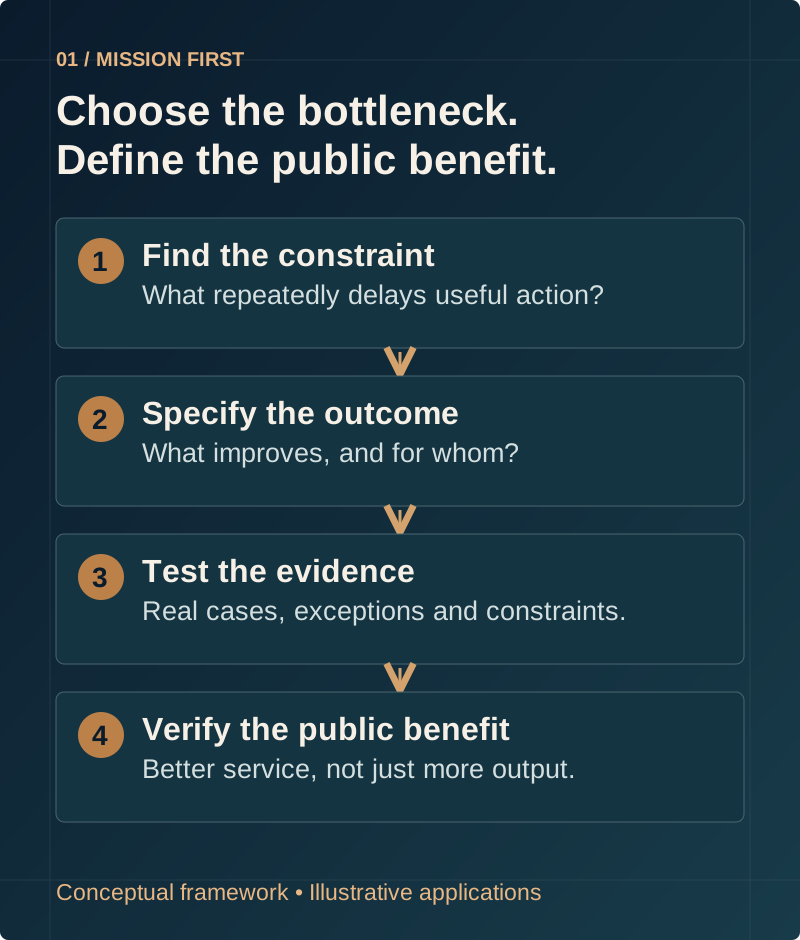
The most useful lesson from AlphaFold is the choice of problem. Predicting protein structures addressed a scientific bottleneck whose removal could help many other researchers. Its value extended beyond the team that built it.
Public leaders should look for comparable bottlenecks in their own missions. Where does uncertainty repeatedly delay useful action? Which expensive search process prevents specialists from examining enough alternatives? What shared capability could improve several programs rather than one office’s productivity statistics?
Potential candidates include helping researchers identify promising materials, improving the analysis behind infrastructure maintenance, or exploring emergency-response options before an incident. These are illustrative opportunities, not assertions that an existing model is ready to perform them safely.
Administrative assistants still have value. Faster drafting or document retrieval can free staff time. But a portfolio devoted entirely to office productivity may overlook larger public benefits. Leaders should distinguish savings in an internal process from improvements residents can actually experience, such as more reliable services or better-informed preparation for hazards.
Choose problems that can support credible learning
Hassabis identifies three useful conditions for applying his approach: a large space of possible solutions, a reasonably clear objective, and enough data or a sufficiently accurate simulator to learn from.
That is a practical screening tool, with an important public-sector qualification. Government rarely has a single uncontested score to maximize. A faster application process could also become harder to navigate. A more efficient deployment plan could leave remote communities poorly served. Historical decisions may reflect past barriers rather than an acceptable standard for the future.
Before buying a system, define both the desired improvement and the constraints that must hold. Decide whose outcomes count, which errors matter most, and what would make an apparently successful result unacceptable. Involve frontline staff and affected communities where appropriate; they can reveal consequences a technical metric misses.
For a hypothetical maintenance-planning tool, the objective might be to identify high-risk assets sooner. Its evaluation should also consider missed hazards, inspection capacity, geographic coverage and the consequences of acting on a false alarm. A model that generates more alerts is useful only if the organization can turn those alerts into better decisions.
Treat data and validation as public infrastructure
AlphaFold’s reach depended on more than a model. EMBL-EBI describes the work of organizing protein information, running predictions at scale, and making the results searchable and usable. The partnership made approximately 200 million protein-structure predictions openly available in 2022. Predictions remain distinct from experimentally established structures. EMBL-EBI on the infrastructure behind AlphaFold
The public-sector implication is to fund the less visible foundations of AI: documented datasets, provenance, access controls, test cases, integration and ongoing stewardship. A pilot dependent on a specialist’s private spreadsheet will be difficult to scale or audit.
Hassabis also describes the value of testing protein predictions against structures established by experimental researchers. Government needs its own versions of that discipline. Reserve realistic cases for independent evaluation. Compare with existing practice. Include unusual cases and changing conditions, not only the examples on which the system looks strongest.
Simulation can help teams explore rare or hazardous situations, but its assumptions need testing too. A visually convincing environment is not necessarily a valid model for a flood, a transport network or human behavior. DeepMind’s original Genie 2 announcement, for example, described generated worlds lasting up to a minute. That research milestone did not establish a validated emergency-planning simulator. DeepMind’s December 2024 Genie 2 announcement
The procurement question should be concrete: what evidence would justify operational use here, and who can challenge it?
Separate a system’s intelligence from its authority
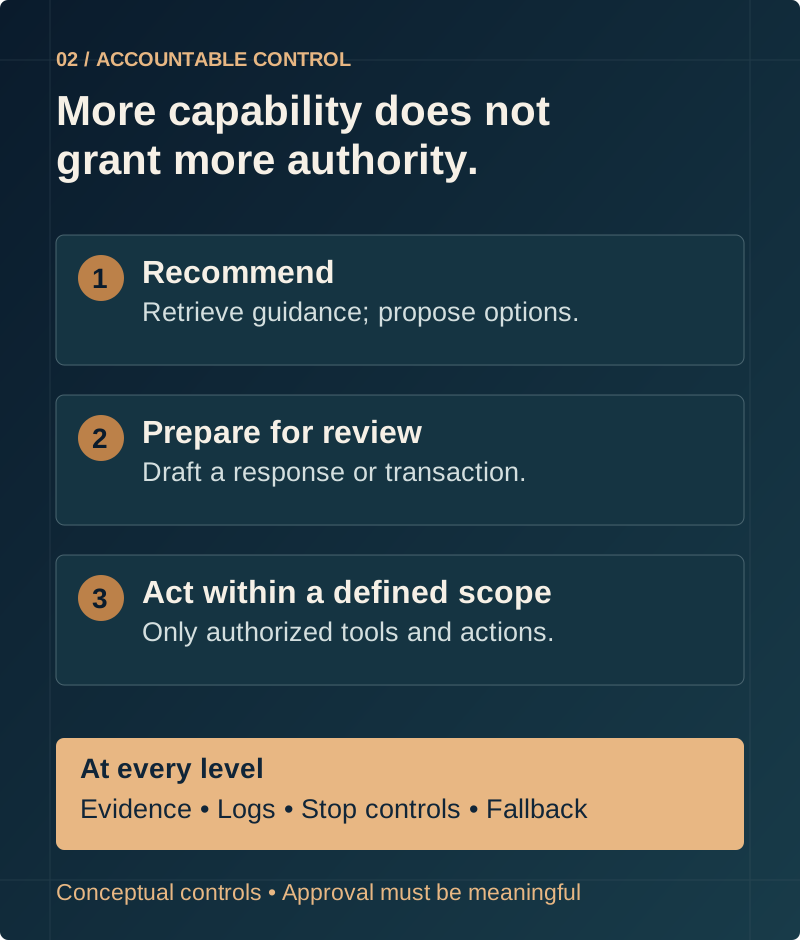
The lecture points toward combining general models with search and planning so that AI can pursue goals and take actions. For government, that changes the design problem. A tool that recommends an action and a tool that carries it out need different controls.
A hypothetical public-service assistant might begin by retrieving guidance. A later version could draft a response or prepare a transaction for review. Giving it permission to alter an official record, communicate a binding decision or release funds creates a different level of exposure.
Design that progression explicitly. Specify which information the system may access, which tools it may use, which actions require approval and what must stop when confidence or conditions deteriorate. Keep action records that allow staff to reconstruct what happened. Provide a practical way to suspend the system and continue the service.
A human approval step is useful only when the reviewer has enough time, information and authority to challenge the recommendation. Otherwise, it can become a formal checkpoint that conceals automated decision-making.
These are design recommendations, not a claim that one control scheme satisfies every jurisdiction’s obligations. NIST’s voluntary AI Risk Management Framework offers a common structure for governing, mapping, measuring and managing risk; implementation still needs to fit the mission and applicable requirements. NIST AI Risk Management Framework
Build a workforce that can question the system
In the lecture’s discussion of careers, Hassabis emphasizes technical foundations and the ability to learn quickly. For public institutions, the corresponding workforce strategy should reach beyond teaching employees to write better prompts.
Domain experts need to recognize when a plausible answer conflicts with operational reality. Engineers need access to the people who understand exceptions and service conditions. Acquisition, security and governance specialists need enough technical understanding to test a supplier’s assurances rather than simply collect them.
Assign clear ownership of the mission outcome, technical performance and deployment decision. Preserve the datasets, evaluation results and decision records so that capability survives staff turnover or a change of vendor. Training should include failures and escalation, not only successful demonstrations.
Smaller jurisdictions can benefit from shared testing resources and reusable tools, but local conditions still matter. A result established in one large agency does not automatically establish readiness in a county with different data, staffing and residents’ needs.
Prepare for stronger AI through disciplined delivery now
Superintelligence describes a prospective level of capability, not a product milestone established by this lecture. Governments should prepare for more capable systems without making public services dependent on an assumed arrival date.
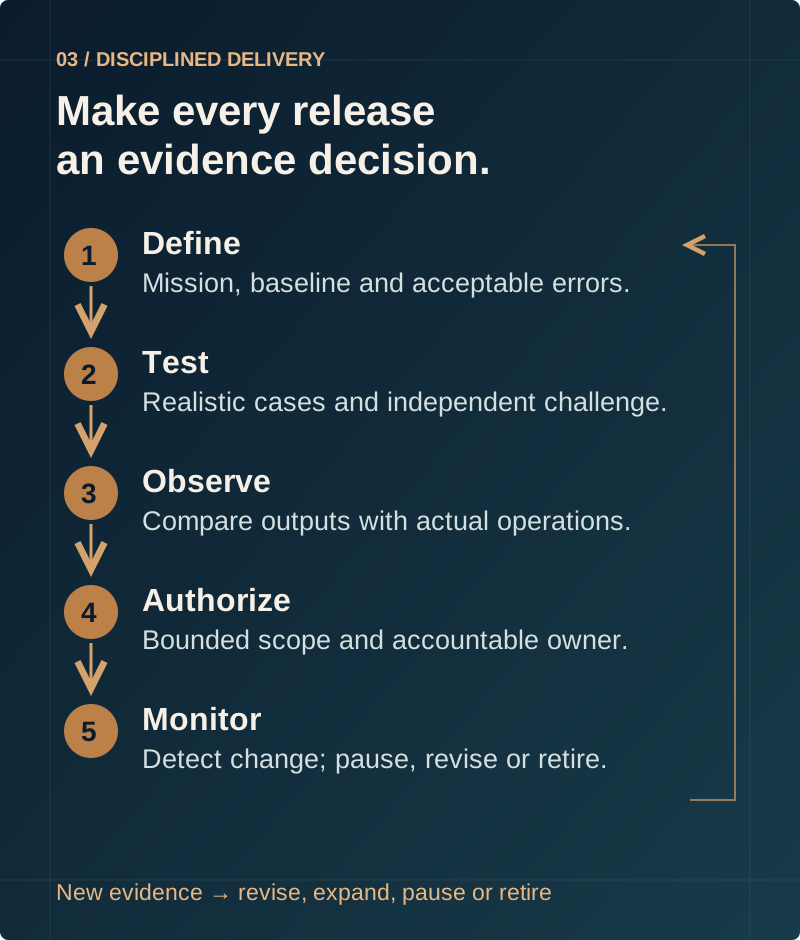
Start with a bounded mission problem and a responsible owner. Establish the baseline, necessary data, acceptable errors and prohibited actions before deployment. Test in a controlled setting, then compare proposed outputs with real operations without allowing the system to act independently. Expand use only when the evidence supports it, with monitoring and a workable fallback.
The pace can vary with the consequences. A reversible internal drafting tool and a system influencing an essential public service should not face identical release decisions. Both should have a clear account of what they are expected to improve and how the organization will know.
Hassabis’s broader vision is ambitious. The immediate public-sector lesson is practical: build institutions that can identify valuable problems, test unfamiliar capabilities and remain accountable for their use. Those habits can produce benefits now and become more important if much stronger AI arrives.