Research & Insights / Energy & Infrastructure
Power Is Becoming an AI Advantage and Orbit Is the Next Test
Electricity access is becoming a competitive advantage in artificial intelligence. Government must expand reliable infrastructure without handing communities the bill—and evaluate orbital computing as an experiment, not an escape hatch.
An AI system can be ordered before the infrastructure needed to run it is ready. That mismatch is becoming an important source of competitive advantage. A company with dependable electricity, a usable grid connection and an effective cooling system can put computing equipment to work while a rival waits.
For government, this is more than a technology-industry problem. Infrastructure decisions shape where investment lands, what public agencies pay for computing and whether households inherit costs from projects that never reach their promised scale. The question is not simply how to supply more power. It is how to turn that power into useful, resilient computing without weakening the public systems around it.
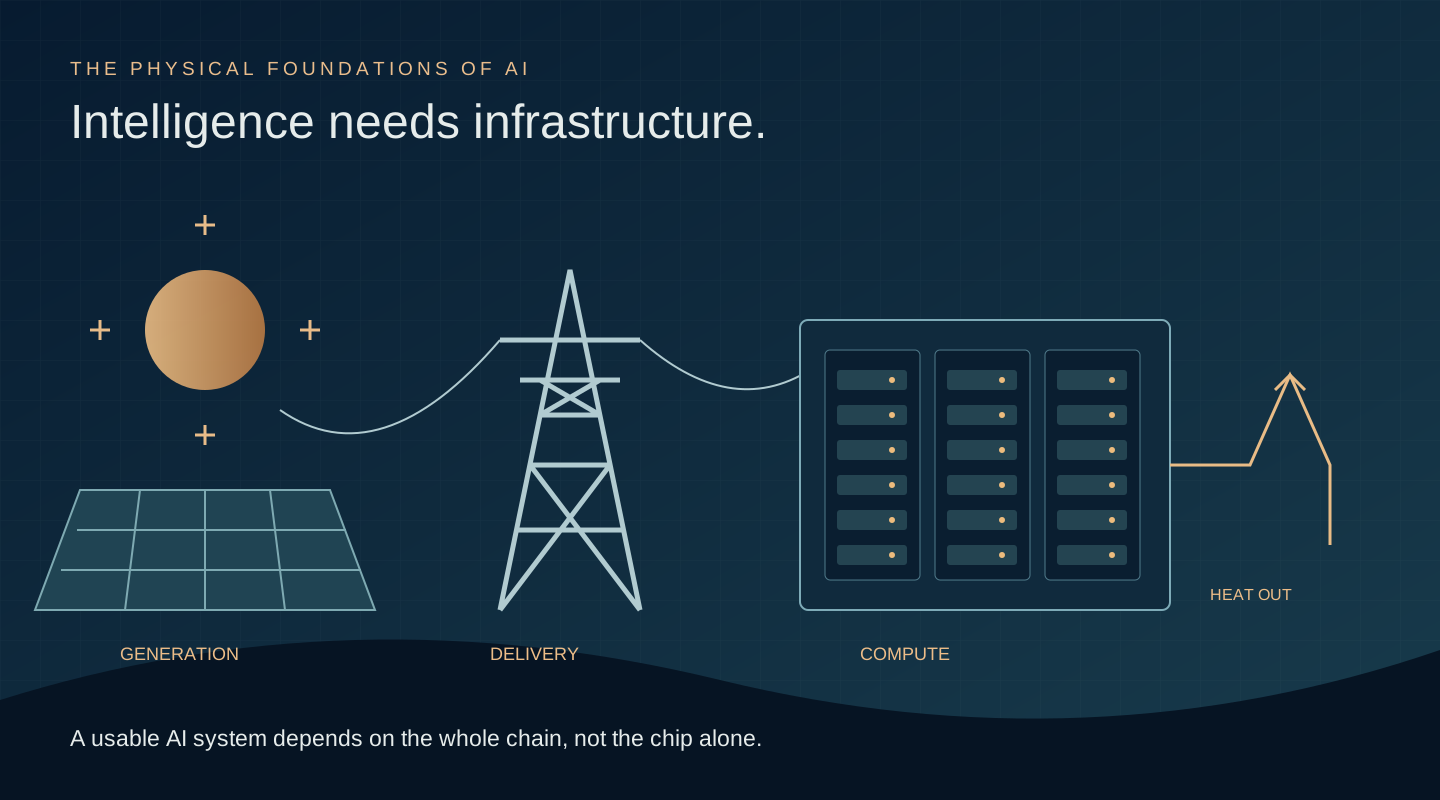
The scarce resource is usable power
Electricity demand is rising, but projections need dates and boundaries. Berkeley Lab’s June 2026 update estimates that all U.S. data centers—not AI alone—used 192 terawatt-hours in 2024, or 4.7% of national electricity consumption. Its reference case reaches 649 terawatt-hours in 2030; a wider uncertainty range spans 521–843 terawatt-hours, or 9.5%–15.3% of projected U.S. consumption. These are modeled scenarios, not orders already placed or an inevitable outcome. Berkeley Lab report
The distinction matters. Better hardware, different model architectures and changes in utilization can alter demand. Public officials should plan for several trajectories rather than turn a high-end forecast into a guaranteed utility revenue stream.
Meanwhile, connecting new supply remains difficult. Berkeley Lab’s 2026 queue study identified 1,312 gigawatts of generation and 749 gigawatts of storage seeking transmission interconnection at the end of 2025. For projects completed in 2025 in regions with available data, the median time from request to commercial operation exceeded five years. Crucially, that dataset covers generation and storage requests, not data-center load connections. It is evidence of an infrastructure bottleneck, not a count of electricity already available to AI developers. Berkeley Lab queue study
The competitive asset is therefore a complete delivery chain: generation that can perform when needed, transmission capacity, substations and a credible connection schedule. Buying annual renewable-energy certificates is not equivalent to securing power at a particular facility during a stressed hour. Policymakers should judge proposals by deliverable capacity and system effects, not headline megawatts.
Communities cannot be the balancing account
New demand can support investment and local tax revenue. It can also expose existing customers to infrastructure costs if a developer cancels, delays construction or consumes less than forecast. The relevant question is who bears that risk.
Virginia’s legislative watchdog identified long-term service commitments, minimum charges, exit fees and stronger financial security among tools for protecting ratepayers. Those are practical starting points for scrutiny, not a single tariff suitable for every utility. Contracts should make commitments enforceable without treating every proposed campus as certain future demand. JLARC independent analysis
Water deserves the same specificity. A statewide average cannot tell a town whether an additional facility is compatible with its drought plan. Review should distinguish withdrawals from consumption, potable from reclaimed water, and annual use from peak-day demand. Officials should compare cooling options across both water and electricity impacts rather than assume that minimizing one automatically minimizes the other.
Residents also need accessible evidence about noise, backup generation, transmission corridors and cumulative development. Public participation should help determine conditions before approvals become irreversible. Faster permitting is valuable when it removes duplication; it is not valuable when it merely transfers unresolved costs to neighbors.
Orbital computing has moved into experiments
Space offers an intriguing alternative: collect solar energy above the atmosphere and perform computation near that power source. Favorable orbits can provide prolonged sunlight, but actual output still depends on orbital geometry, array design and system losses. Reliable service also requires communications, thermal control and fault management.
There is now more to discuss than a concept drawing. On October 1, Google reported that its Project Suncatcher prototype, built with Planet, had launched and established contact. Its stated purpose is to gather evidence about TPU hardware under spaceflight, radiation and thermal conditions—not to announce a commercially proven replacement for terrestrial data centers. Google mission update
NVIDIA announced its Space-1 Vera Rubin Module in March and said in August that SpaceXAI’s planned first-generation Starmind satellite would use an optimized Vera Rubin rack-scale system. These announcements establish engineering programs and intended hardware choices. They do not establish fleet availability, service reliability or cost competitiveness. NVIDIA space platform · NVIDIA Starmind announcement
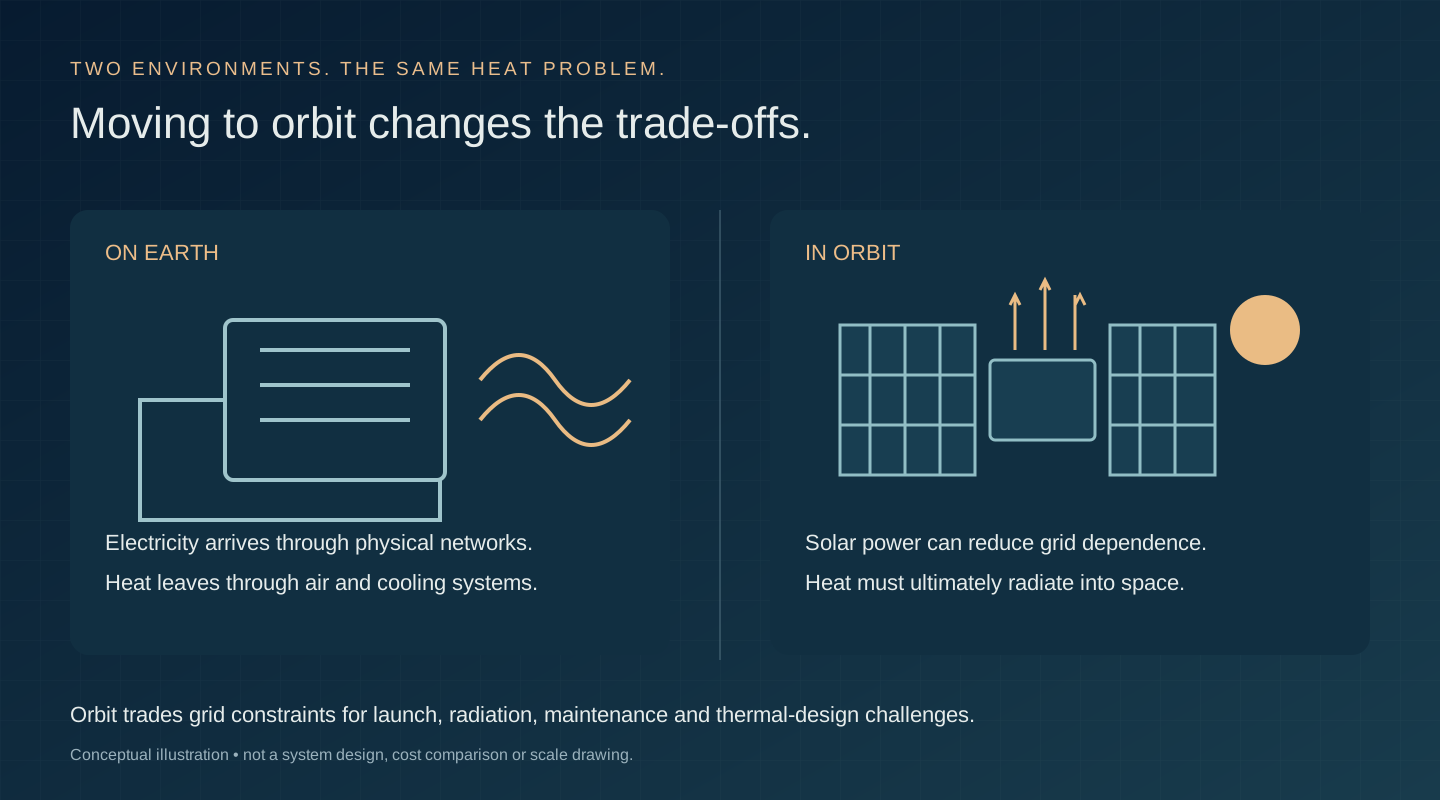
Space changes the constraints rather than removing them
The coldness of space does not make cooling automatic. A vacuum supplies no surrounding air to carry heat away. Heat can move through a spacecraft by conduction and engineered fluid systems, but external radiators must reject it through thermal radiation. NASA’s thermal guidance emphasizes radiator area, surface properties and environmental heating, including sunlight and infrared energy from Earth. NASA thermal-control guidance
Larger radiators add mass and deployment complexity. Higher operating temperatures can improve heat rejection but must remain compatible with electronics and materials. Radiation resilience, replacement strategy and high-bandwidth connections create additional tests. A successful chip demonstration is not the same achievement as operating a tightly coupled computing cluster for years.
Economics is equally conditional. Google’s research describes a pathway under which launch prices could fall below $200 per kilogram by the mid-2030s. That is a learning-curve projection, not today’s generally available price. Its comparison concerns launch and operating costs against terrestrial energy costs, not proof that every component of an orbital service will be cheaper. Google system-design research
Public buyers should ask for cost per completed workload at a specified availability, including communications, spare capacity, replacement launches and disposal. Moving equipment off Earth also does not remove environmental responsibility: orbital congestion, debris and launch impacts belong in the assessment.
What government should do now
Federal agencies should strengthen infrastructure planning while buying computing more intelligently. Procurement teams can demand energy and performance reporting, test smaller models where adequate, and distinguish time-critical workloads from jobs that can move to less-constrained hours or regions. Any orbital pilot should have independent evaluation, cybersecurity controls, data-handling requirements and a terrestrial fallback.
State regulators and energy offices should test competing demand forecasts, require credible financial commitments and make infrastructure cost allocation understandable. Reliability should remain explicit: a faster connection is not a success if the resulting service cannot be sustained. FERC’s June 2026 large-load orders similarly pair integration reforms with consumer safeguards and transmission-cost transparency. FERC announcement
Local governments and water utilities should coordinate land-use decisions with power and water planning before promising incentives. Approval conditions should address drought operations, noise, emergency response and measurable community benefits. Technical assistance can help smaller jurisdictions negotiate on informed terms rather than accept a developer’s assumptions by default.
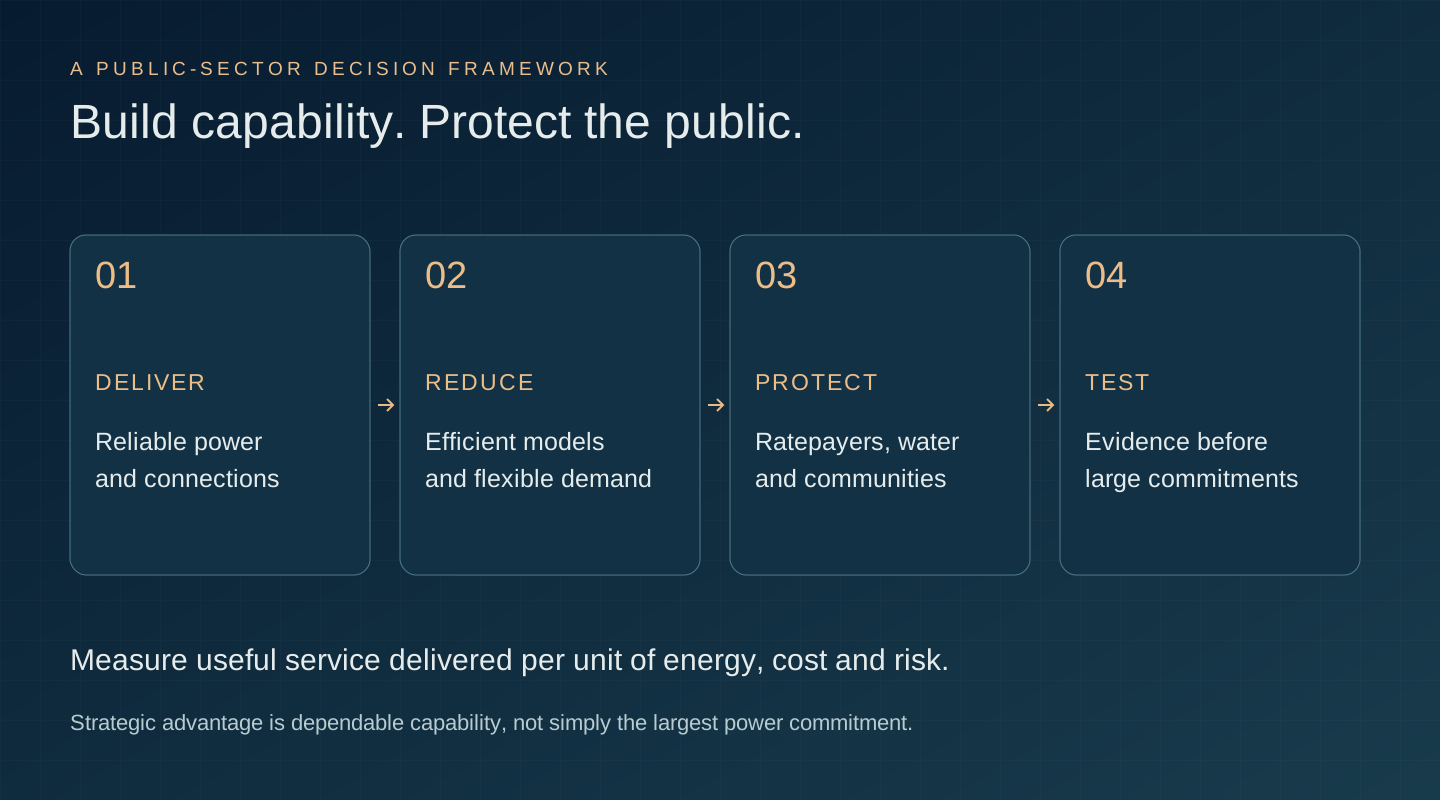
Build capacity without betting public services on a forecast
Power access can become an AI advantage, but durable advantage comes from a system that works: efficient computing, dependable supply and public confidence in how costs are shared. Orbital computing deserves serious experiments and demanding evidence. It does not justify postponing grid improvements or weakening protections on Earth.
The public-sector task is to support useful innovation while keeping promises proportional to what has actually been demonstrated.