Research & Insights / Original Analysis
Exceptional AI Talent Needs Better Leadership
Businesses and public agencies can hire outstanding technical people and still waste their abilities. The harder leadership task is recognizing expertise, giving it room to matter, and building teams that turn it into dependable results.
An organization can win a fiercely contested AI hire, announce its commitment to innovation, and then spend the next year preventing that person from doing useful work.
The specialist gets a broad transformation mandate but no access to usable data. Every technical decision needs approval from people who cannot evaluate it. Advancement means supervising a larger team. Success is measured in presentations, while the hardest operational problems remain untouched.
Before leaders declare a talent shortage, they should ask a more uncomfortable question: would exceptional talent be effective here if it arrived tomorrow?
Some technical contributions have outsized consequences. An engineer who discovers a flawed architectural assumption can change an entire project’s direction. A researcher who designs the right evaluation can expose a system’s weaknesses before deployment. Their value may lie in avoiding months of unnecessary work, rather than producing more work visibly.
Recognizing that possibility does not require a mythology of genius. It requires leaders who can distinguish consequential expertise from impressive performance—and an institution capable of using it.
Learn to recognize work you cannot do yourself
Senior leaders do not need to be their organization’s best model builders. They do need a reliable way to judge model-building expertise.
Without one, familiar signals can dominate: credentials, confidence, polished explanations, recognizable employers. Those signals may provide context, but none establishes whether someone can diagnose the problem the organization actually faces. A technically weak answer can sound reassuring. A strong answer may begin by challenging the question.
Build evaluation around observable work. Give candidates a bounded, realistic problem: investigate why an AI assistant produces plausible but unsupported answers, assess an evaluation dataset, or explain how they would test a proposed automation before release. Ask what they would measure, what assumptions they would challenge, and what evidence could change their recommendation.
For an experienced role, a short work sample can reveal skills needed on arrival. For a developmental role, distinguish existing competence from what the organization intends to teach. The U.S. Office of Personnel Management makes this distinction in its guidance on work samples and simulations, which describes assessments built around tasks resembling the job.
Have credible technical peers review the work against a shared rubric. Include a domain specialist who can judge whether the proposed solution addresses the real operational need. Keep exercises proportionate, use safe data, and establish expectations about AI assistance and accommodations in advance. A hiring exercise should not become unpaid production work.
Then test the reasoning in a structured conversation. OPM’s structured interview guidance uses predetermined questions and consistent rating standards. Use that structure to give unconventional candidates a fair opportunity to demonstrate relevant capability without making personal familiarity the hidden qualification.
The same discipline belongs in procurement. Evaluate the people and evidence behind a supplier’s demonstration, not just the presentation.
Stop making management the price of advancement
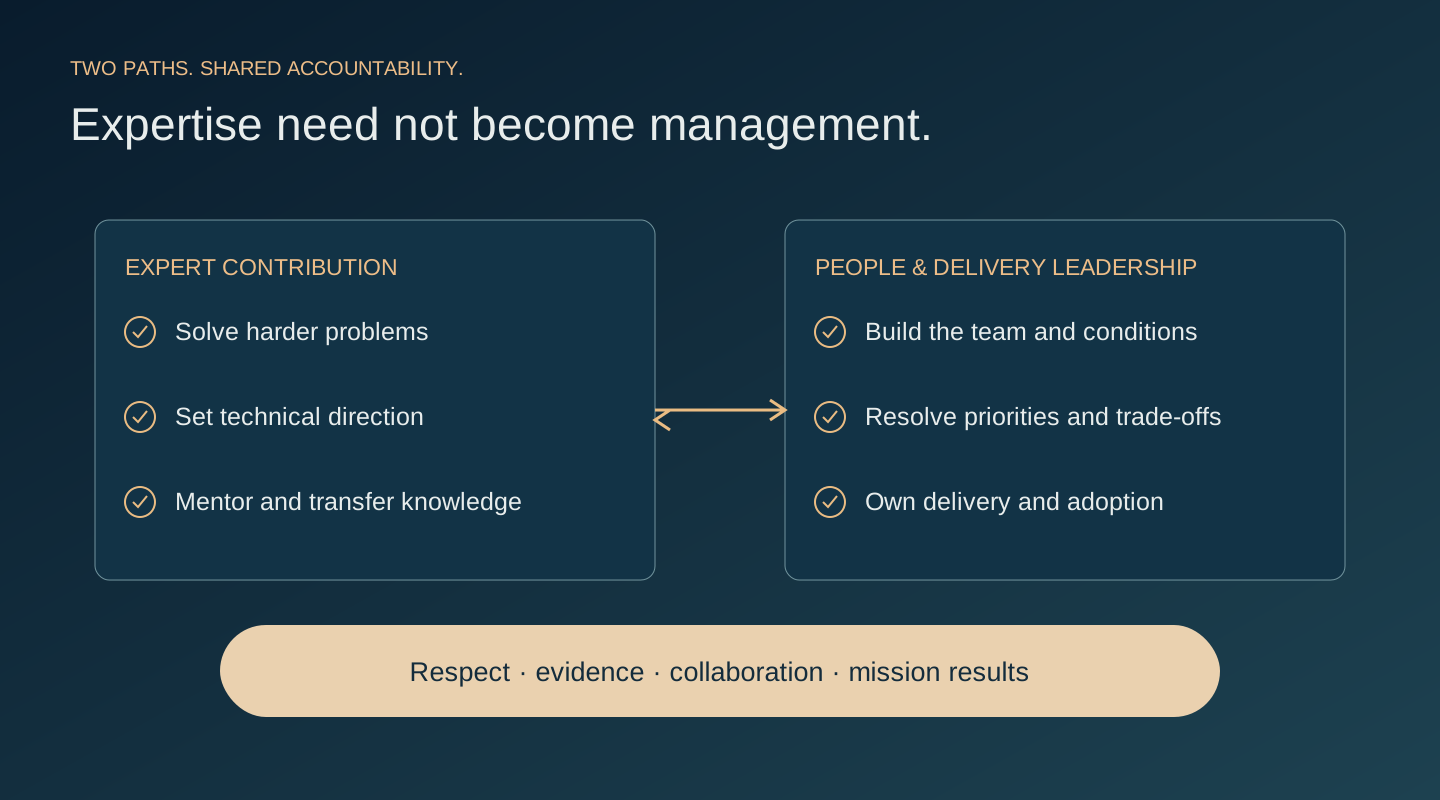
Technical judgment and people management are different responsibilities. Some people excel at both. Others make their strongest contribution by solving difficult problems, setting engineering standards, or helping colleagues reason through unfamiliar territory.
When the only prestigious career path leads toward larger reporting lines, an institution creates a perverse bargain: to progress, experts must spend less time doing the work that made them valuable.
Create a credible individual-contributor path alongside the management path. Senior experts should have meaningful influence over technical decisions, access to leadership, and recognition appropriate to their contribution. A title without decision rights will not solve the problem.
Make the expectations explicit. An expert might own evaluation quality, architectural coherence, or the resolution of a difficult technical risk. A manager might own staffing, coaching, workload, and team performance. Both should contribute to delivery; neither should have to pretend to perform the other’s entire job.
Public bodies must design roles and rewards within applicable classification, pay, and employment arrangements. That is a design constraint to work through with human-resources specialists, not a reason to assume that excellence must always be rewarded with direct reports.
Technical leadership still includes communication. Experts owe colleagues explanations that support decisions, documentation others can use, and respectful engagement with challenge. Organizations can support those responsibilities without demanding that every outstanding specialist become a department head.
Build a complementary team around the problem
A brilliant technical solution can fail because it solves the wrong problem.
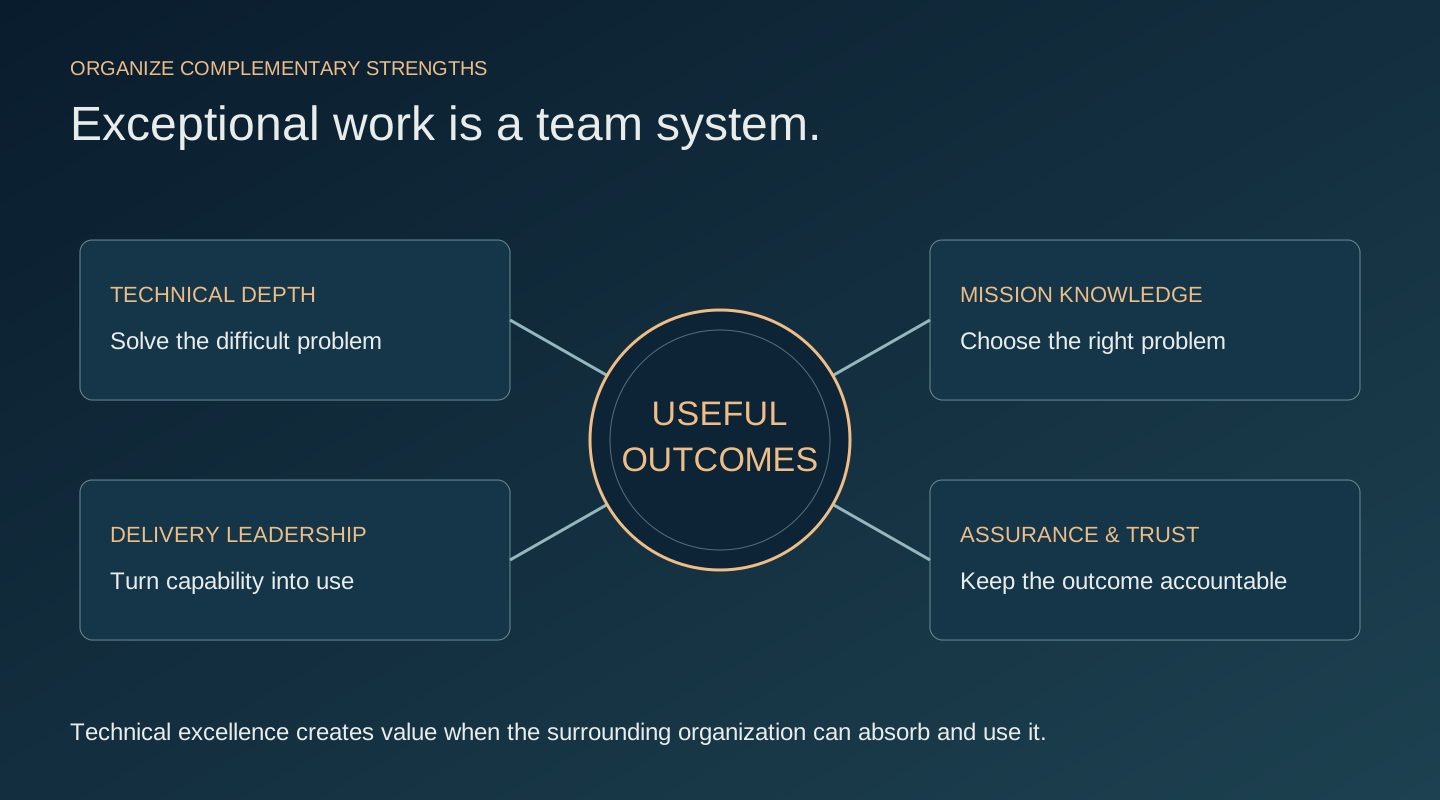
Consider a hypothetical AI tool for processing applications. An engineer may improve extraction accuracy dramatically. A frontline specialist may recognize that an apparently missing field reflects a legitimate exception. A service designer may discover that applicants cannot understand the instructions. A governance partner may identify an accountability gap when staff disagree with the model.
Each changes what a successful system must do.
Industry faces the same problem in customer service, claims handling, manufacturing, and logistics. Domain knowledge is part of the engineering input. Treating it as feedback to collect after the prototype is finished makes avoidable rework more likely.
Bring technical experts, operational staff, product or service owners, and relevant risk specialists together early. Give each a clear responsibility. Decide who defines success, who tests performance, who authorizes deployment, and who can pause a system when evidence changes.
This approach is consistent with NIST’s AI Risk Management Framework 1.0, which calls for multidisciplinary perspectives and continuous risk management across the AI lifecycle. Its practical implication for leadership is straightforward: technical authority should operate within a team that can see consequences the technical specialist may miss.
Do not turn that team into a committee that must unanimously approve every implementation detail. Separate decisions specialists can make independently from consequential decisions requiring wider review. Clear boundaries protect both speed and accountability.
Protect concentration and require evidence
Recruiting a specialist into a calendar full of status meetings is an expensive way to acquire slide production.
Give difficult work sustained attention, usable tools, and a defined route through dependencies. If access to data, testing environments, or decision-makers is blocked, the leader should help resolve the blockage. Repeatedly asking the expert to demonstrate urgency will not remove it.
Pair that support with specific commitments: a problem statement, a testable hypothesis, a review date, and evidence of progress. An early milestone might be a reproducible baseline or a finding that rules out an attractive but unsuitable approach. Later milestones should demonstrate operational value and readiness for support.
Autonomy does not mean immunity. Technical ability is no excuse for intimidation, contempt, withheld knowledge, or ignoring safety requirements. Nor is an unusual personality proof of exceptional talent. Judge the contribution and the conduct separately, with clear standards for both.
The expert who makes everyone dependent on private knowledge creates a fragile institution. The expert who builds reusable tests, explains critical decisions, and develops colleagues leaves it stronger.
Make the institution learn from delivery
A training catalogue can expand while an organization’s ability to deliver remains unchanged.
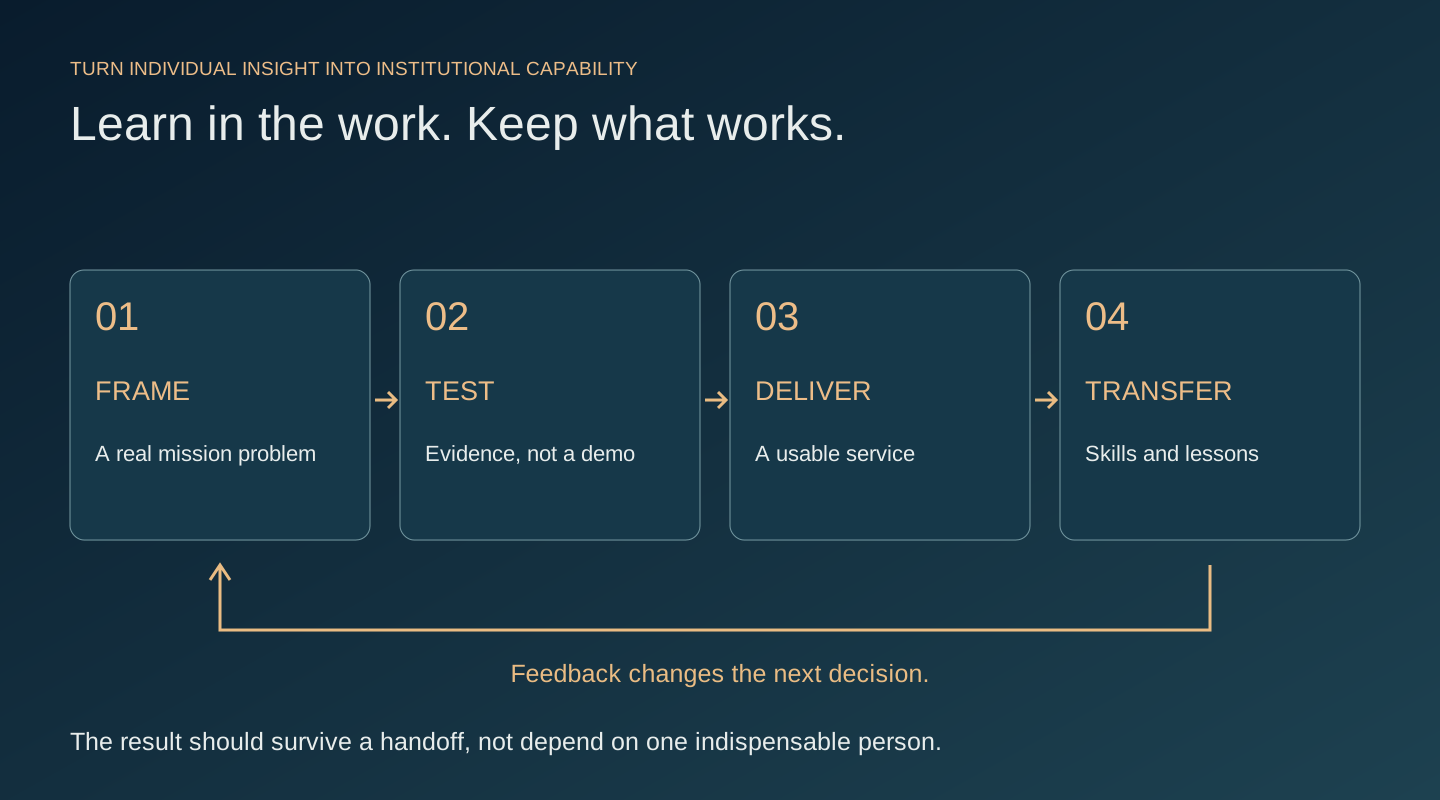
Build learning into real work. Pair emerging specialists with experienced practitioners on bounded problems. Review decisions after outcomes become visible. Preserve the evaluation cases, operational feedback, and explanations that made a result possible. Revisit a failed assumption rather than quietly replacing the presentation.
Neither failure nor success teaches automatically. A failed pilot can become an excuse to avoid the technology entirely. A successful pilot can encourage unjustified confidence. Teams need to understand what happened, under which conditions, and what should change next.
For public agencies, fair assessment and institutional learning belong together. OPM notes that agencies remain responsible for assessments meeting applicable requirements and for maintaining supporting documentation. Work with the appropriate specialists to make evaluation rigorous and defensible rather than inventing exceptions for a favored candidate.
Companies should apply the same underlying discipline: write down what good work looks like, compare expectations with outcomes, and improve the process. Avoid building a system that recognizes excellence only when it resembles the people already in charge.
The leadership test
Start with one consequential problem. Put credible evaluators close to the work. Give a technical expert clear authority, a capable operational partner, and a delivery goal. Remove an unnecessary barrier. Review the evidence together, and ensure that what the team learns survives beyond the project.
Exceptional talent matters. So does the surrounding workforce that turns a promising idea into a reliable service. Leaders who neglect either will struggle to get the value of both.
The real test is whether the institution becomes more capable because an expert worked there—and whether that expert could achieve something there that they could not achieve alone.