Research & Insights / Research Article
Founders, Managers, and Government’s Capacity to Change
Marc Andreessen’s argument about founders and managers raises a public-sector question: how can institutions reinvent their work while continuing to deliver dependable services?
A government agency can meet its reporting deadlines, keep its systems running, and still become less capable of serving the public as conditions change. That possibility gives Marc Andreessen’s argument about founders and professional managers its relevance beyond Silicon Valley.
In his conversation with David Senra, published by a16z on March 15, 2026, Andreessen describes a historical bargain: founders create enterprises; trained managers take over when those enterprises become too large and complicated for personal direction. He accepts the need to operate at scale. His challenge is whether managers trained to administer an established model can adapt when technology changes that model’s foundations.
For public institutions, the useful question is how to preserve the ability to rethink a service while continuing to deliver it. The research supports taking that problem seriously. It offers much less support for treating founders and managers as two fixed types of people.
What the management discipline was built to accomplish
Modern management addressed real coordination problems. Frederick Winslow Taylor’s The Principles of Scientific Management (1911) sought to replace informal work methods with systematic analysis, training, and cooperation. His stated ambition included prosperity for both employers and employees. He also sought an operating system that would make performance less dependent on finding an extraordinary individual.
Alfred Chandler’s The Visible Hand (1977) provides a broader historical account. Railroads, communications networks, and mass production required salaried managers to coordinate activities across dispersed units. Management was itself an organizational innovation that helped enterprises use new technologies at scale. Its historical purpose cannot be reduced to preserving an unchanging status quo.
A distinction in the interview matters here. James Burnham wrote The Managerial Revolution in 1941 and The Machiavellians in 1943. The excerpt names the latter while discussing the rise of managerial control associated with the former. Burnham’s account concerns institutional power and control; whether a particular manager can lead technological change is a separate question.
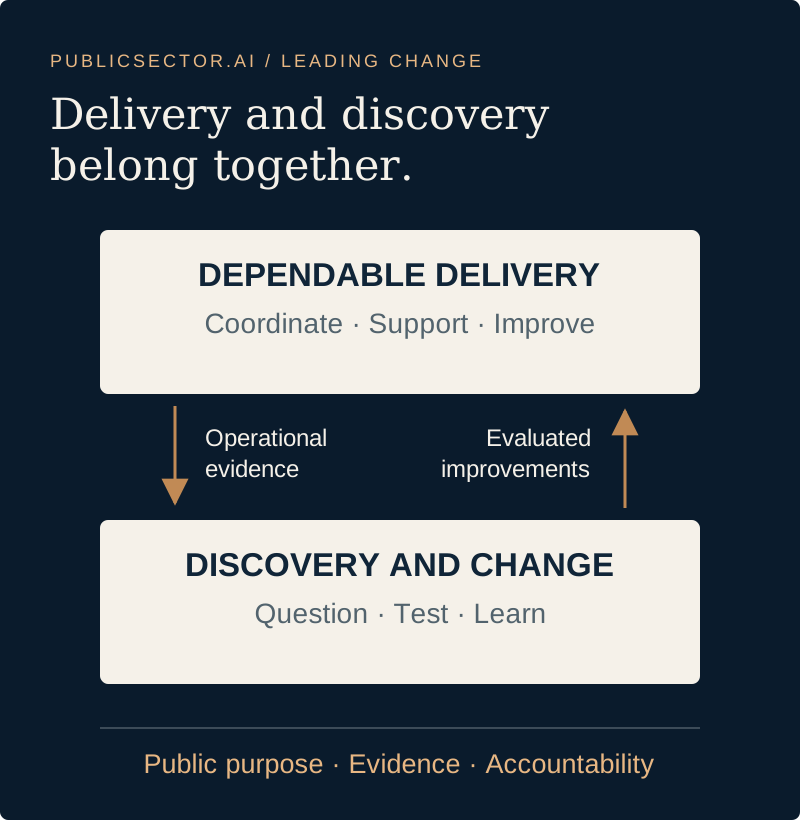
For government, the continuing value of management is concrete: coordinating budgets and people, maintaining reliable services, preserving institutional knowledge, and making responsibilities visible. Those functions remain necessary when an agency adopts AI or redesigns a service. The challenge is whether its operating routines can also accommodate discovery.
Where Andreessen’s argument is strongest
Andreessen points to a real strategic danger: becoming exceptionally good at a method whose assumptions no longer hold. A leader can improve the throughput of an existing process while overlooking an opportunity to eliminate much of that process.
James March’s 1991 research on exploration and exploitation explains this tension without assigning it to a personality type. Exploitation improves what an organization already knows how to do. Exploration searches for alternatives. March’s models show how learning can favor familiar activities, producing short-term competence while weakening longer-term adaptation. This is a theoretical explanation, rather than a direct test of founder superiority.
Read this way, Andreessen’s strongest point concerns what leaders notice and are permitted to challenge. A founder may have detailed knowledge of the original problem, unusual commitment, and authority to overturn an established decision. Those advantages can matter after the organization becomes large. They also suggest capabilities an institution can deliberately develop in people who did not found it.
The distinction has practical consequences. A public manager asked to improve a queue may optimize staffing. A leader given responsibility for the whole service may discover that confusing instructions and repeated requests for the same information create the queue. Both contributions can be valuable; the second requires permission to reconsider the work itself.
What the evidence supports—and what it does not
Founders can contribute something distinctive
Lee, Kim, and Bae’s 2020 study examined U.S. publicly listed companies experiencing sudden CEO deaths between 1979 and 2002. Replacement of a founder CEO by a professional CEO was associated with a 43.8 percent decrease in citation-weighted patent counts, even after accounting for research and development spending. The authors also found evidence of more exploratory patenting and stronger retention of inventors under founders.
This supports taking founder contributions seriously. It does not establish that founders are superior across all tasks. Patent output measures one aspect of innovation; sudden succession is a particular disruption; and publicly listed companies are not public agencies. The study cannot determine the best leadership arrangement for a benefits office or a government modernization program.
Management practices also produce measurable value
In a randomized experiment reported by Bloom and colleagues in 2013, consulting on management practices raised productivity in participating Indian textile plants by 17 percent in the first year through improvements in quality, efficiency, and inventory. This is stronger evidence of a causal effect than a comparison of prominent business leaders, although it concerns operational improvement in a specific setting, not adaptation to every technological disruption.
Founders do not automatically acquire those practices. Bennett, Lawrence, and Sadun’s research using the World Management Survey found that founder-CEO firms had the lowest management-practice scores among the ownership and leadership categories studied. These are observational findings about measured practices, not a verdict on entrepreneurial imagination. Together, the studies suggest that innovation and disciplined management are distinct contributions; success in one does not guarantee the other.
Public managers can support innovation and execution together
Kousina and Voudouris’s 2023 study used data from 317 public servants across 109 Greek local-government units. Innovative behavior was highest where managers combined behaviors that encouraged experimentation with behaviors that supported execution, such as monitoring goals and correcting problems. Researchers call this combination ambidextrous leadership.
The study used cross-sectional data and supervisor ratings, so it does not establish causation or demonstrate better citizen outcomes. Nevertheless, it directly challenges the assumption that public managers must choose between encouraging new ideas and maintaining delivery discipline.
Context also matters. Rasul and Rogger’s study of 4,700 Nigerian government projects associated greater bureaucratic autonomy with higher completion rates, while some incentive and monitoring practices were associated with lower completion rates. These observational results do not justify abandoning oversight. They do question the idea that an interchangeable management technique will improve every kind of work.
The evidence reviewed here does not establish that managers as a class cannot adapt, or that founders reliably learn to manage scale. It supports a more specific proposition: institutions need both discovery and execution, with leadership practices suited to their tasks and circumstances.
SpaceX also illustrates the value of adaptive public management
Andreessen uses SpaceX to show how a founder can challenge an industry’s assumptions. The example is instructive, but the claim that rockets had always been used only once is too sweeping: NASA’s Space Shuttle flew repeated missions beginning in 1981. Different forms of reuse have different costs and operating characteristics; reuse itself did not begin with SpaceX.
NASA’s Commercial Orbital Transportation Services lessons offer a more useful public-sector connection. The program combined milestone payments, commercial design discretion, and requirements focused on critical needs, including station and crew safety. Its retrospective describes government support and private investment working together, with testing and oversight contributing to delivery.
COTS concerned development of cargo transportation capability; it is not a controlled study of founder leadership or a direct explanation of later booster reuse. Its relevance is institutional: public officials could change how government worked with suppliers while retaining responsibility for the mission. Entrepreneurial initiative and capable public management were complementary parts of that arrangement.
Government needs adaptation that has public legitimacy
A public agency is entrusted with authority; it is not the personal enterprise of its leader. Its purposes, resources, and obligations cannot be reset solely because an executive has a compelling vision. This difference shapes how founder-like initiative can translate into public service.
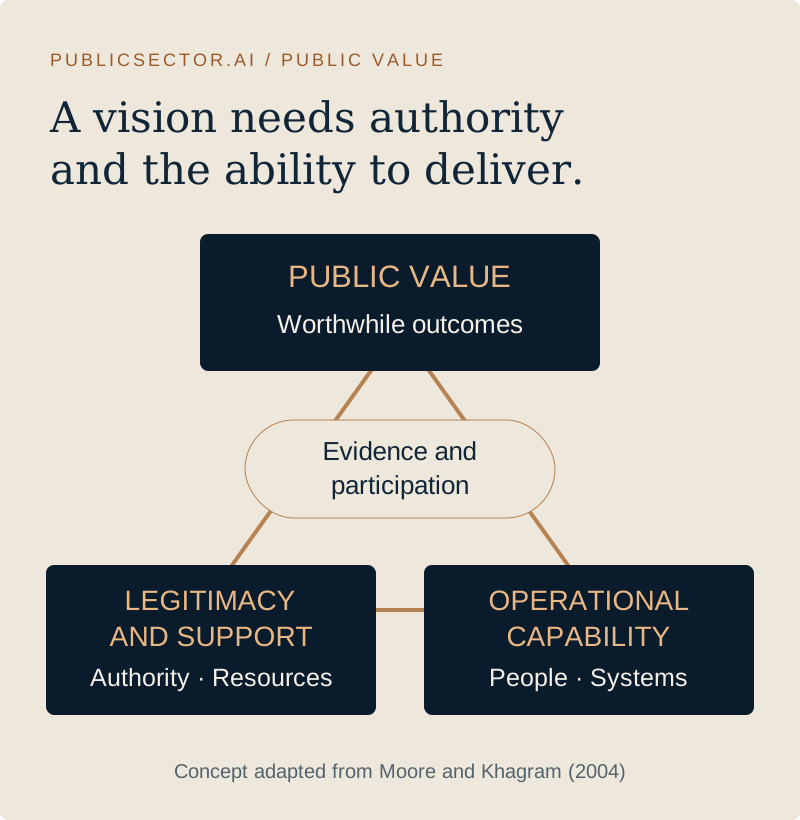
Mark Moore and Sanjeev Khagram’s public-value framework connects three questions: what value should be created, what legitimacy and support authorize the work, and what operational capabilities can deliver it? The framework is conceptual, but it identifies a gap in importing a founder narrative into government. Conviction must be accompanied by authorization, public justification, and the means to perform.
That still leaves substantial room for initiative. Leaders can challenge an inherited workflow, convene people across organizational boundaries, and sponsor a bounded trial. They must distinguish an obsolete internal habit from a substantive public obligation, and seek the appropriate authority where a proposed change exceeds their discretion.
Public institutions also need continuity through leadership transitions. A reform whose knowledge and authority reside entirely in one champion is vulnerable when that person leaves. A practical test of change leadership is whether successors and frontline teams can sustain, question, and improve the service.
Research that makes adaptation practical
Andrews, Pritchett, and Woolcock’s Problem-Driven Iterative Adaptation starts with locally defined performance problems, authorization to experiment, rapid feedback, and broad participation. Their 2012 working paper warns that institutions can adopt the appearance of reform without developing the ability to perform. It offers a reform approach grounded in development experience, rather than universal experimental proof. Its connection to Andreessen is direct: changing the organization chart or buying a new system does not demonstrate that an institution can learn.
The OECD’s 2022 work on adaptive innovation similarly emphasizes organizational support: space for experimentation, partnerships, evaluation, and learning. This is a research synthesis and policy framework, not evidence that any single innovation model guarantees success. It helps explain why demanding more entrepreneurial behavior from individuals is insufficient when decisions, resources, and feedback remain unchanged.
Ines Mergel’s Agile and Adaptive Leadership in the Public Sector (2026), already part of this site’s research collection, makes an especially relevant connection. It treats agile leadership as more than adopting project rituals: leaders must support cross-functional work, iterative learning, and conditions in which teams can surface problems. The report’s practical guidance locates adaptive capacity within public management itself. It also raises a challenge for founders: leaders who insist on their own answer despite contrary evidence can impede adaptation.
What this means for leading government change
The following recommendations are a PublicSector.ai synthesis of the sources, not a framework tested as a whole.
Give someone responsibility for the outcome and authority to learn
Assign a named service owner a concrete problem, such as reducing the time people spend correcting an application. Specify decisions the team can make, resources available, dependencies requiring escalation, and the evidence needed to continue. This creates meaningful responsibility without implying personal ownership of a public institution.
Bring discovery into the operating team
Pair operational and technical expertise with frontline staff, service users, and relevant oversight functions. Observe where the service fails and test alternative explanations. A short trial should answer a specific uncertainty. It should also have a planned route into normal operations if it succeeds, including staffing, training, support, and funding.
Measure improvement and learn from the exceptions
Consider a hypothetical AI assistant that helps staff prepare application reviews. Measure total completion time, correction rates, staff verification effort, and differences across case types. A fast draft that increases rework is not necessarily an improvement. Keep consequential decisions with authorized staff, use appropriate data controls, and define when the trial should pause.
The same discipline applies to a shared-services migration. Common processes and standards can support scale, while documented exceptions reveal where a service needs adaptation. Review those exceptions as evidence: some justify a design change; others reveal a training or data-quality problem. Avoid equating either uniformity or customization with success in advance.
Make learning survive the champion
Preserve decision records, user findings, evaluation methods, and unresolved questions. Develop deputies and team expertise. Reward managers for retiring ineffective work as well as delivering commitments. Ask leaders to demonstrate when evidence changed their approach; ask innovators to show how their improvements will remain reliable after expansion.
Make the capacity to change part of management
Andreessen is persuasive when he warns that running an inherited system well may not prepare an institution to reinvent it. Research supports valuing entrepreneurial judgment and protecting exploration. It also shows why the discipline of management remains useful and why adaptation can be cultivated within public organizations.
Government’s leadership task is to connect those capabilities: recognize when assumptions have failed, authorize people to test alternatives, and turn demonstrated improvements into services that remain accountable and dependable. The measure of success is an institution that can keep learning and delivering after its most energetic champion has moved on.